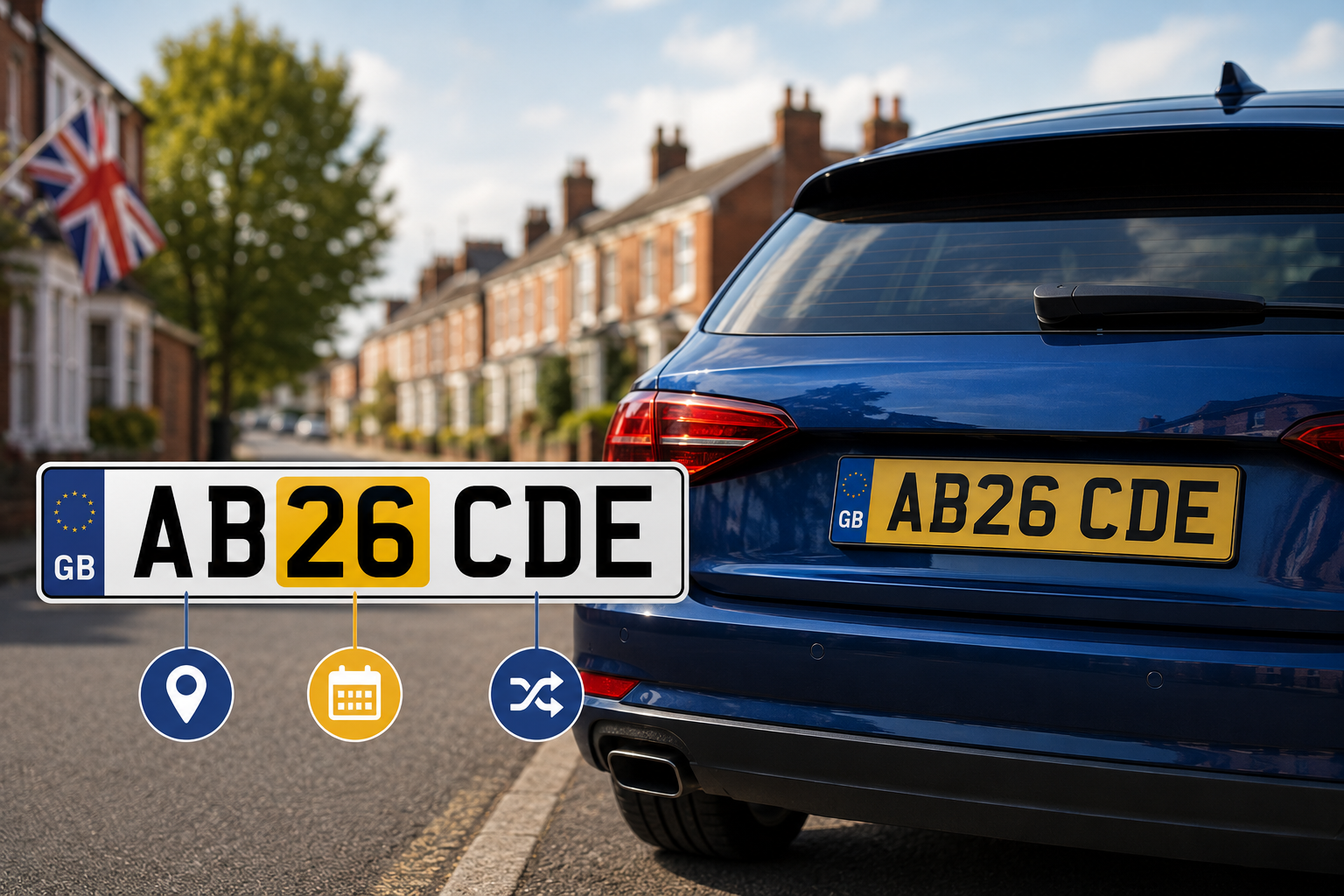

Last updated: 4 August 2026
TL;DR: A current Great Britain registration reads AB26 CDE — the first two letters are the DVLA area the plate was issued in, the two numbers are the six-month age period, and the last three letters are a random sequence. Prefix, suffix and dateless plates follow older rules, and Northern Irish marks carry no age identifier at all, which is exactly why so many buyers ask us about them.
What is the current UK number plate format?
Ask most drivers what their registration means and you get a shrug. It is not random, though — since September 2001 every new Great Britain plate has followed the same seven-character recipe: two letters, two numbers, three letters. Between them they tell you where the plate was first issued and when.
| Example section | Meaning | Example |
|---|---|---|
| First two letters | DVLA local memory tag or registration area | AB |
| Middle two numbers | Six-month age identifier | 26 |
| Final three letters | Randomly allocated sequence | CDE |
Example: AB26 CDE
- A places the registration in the Anglia group.
- B narrows the memory tag within that group.
- 26 indicates the March-to-August 2026 issue period.
- CDE is the random identifier.
From our desk: that last block of three letters is where almost all of the value hides. The DVLA hands them out at random, which means the occasional name, word or set of initials falls out of the system by pure luck — and those are the current-style plates people ring us about.
How do you read a UK number plate?
Once you have done it a few times you will read a plate without thinking. Left to right: area, age, sequence.
- Split the registration into 2–2–3 characters. For example, AB | 26 | CDE.
- Decode the first letter. This is the broad DVLA regional memory tag.
- Check the second letter. This identifies a local allocation within the group.
- Decode the age number. Below 50 and you are looking at the March issue year; above 50, knock off 50 for the September issue year.
- Treat the final three letters as a sequence. They do not normally encode a location or anything about the vehicle.
One thing worth clearing up, because it comes up constantly: a plate records where the vehicle was first registered, not where its owner lives now. A car that started life on a London memory tag can spend the next fifteen years in Aberdeen. Reading a plate as a home address is a mistake — and it is also why we would never advise buying a current-style plate purely because the area letters match where you live.
What are the UK number plate area codes?
The first two letters of a current-style Great Britain registration form the DVLA memory tag. The first letter gives the broad region; the second narrows it to a local allocation.
| First letter | Memory area | Historic/local DVLA allocation | Common code ranges |
|---|---|---|---|
| A | Anglia | Peterborough | AA–AY (selected combinations; I, Q and Z are not normally used in current-style memory tags) |
| B | Birmingham | Birmingham | BA–BY |
| C | Cymru | Cardiff and Swansea | CA–CO Cardiff; CP–CY Swansea |
| D | Deeside | Chester and Shrewsbury | DA–DK Chester; DL–DY Shrewsbury |
| E | Essex | Chelmsford | EA–EY |
| F | Forest and Fens | Nottingham and Lincoln | FA–FP Nottingham; FR–FY Lincoln |
| G | Garden of England | Maidstone and Brighton | GA–GO Maidstone; GP–GY Brighton |
| H | Hampshire and Dorset | Bournemouth and Portsmouth | HA–HJ Bournemouth; HK–HY Portsmouth |
| K | No mnemonic | Borehamwood and Northampton | KA–KL Borehamwood; KM–KY Northampton |
| L | London | London | LA–LY |
| M | Manchester and Merseyside | Manchester | MA–MY |
| N | North | Newcastle and Stockton | NA–NO Newcastle; NP–NY Stockton |
| O | Oxford | Oxford | OA–OY |
| P | Preston | Preston and Carlisle | PA–PT Preston; PU–PY Carlisle |
| R | Reading | Reading | RA–RY |
| S | Scotland | Glasgow, Edinburgh, Dundee, Aberdeen and Inverness | SA–SJ Glasgow; SK–SO Edinburgh; SP–ST Dundee; SU–SW Aberdeen; SX–SY Inverness |
| V | Severn Valley | Worcester | VA–VY |
| W | West of England | Exeter, Truro and Bristol | WA–WJ Exeter; WK–WL Truro; WM–WY Bristol |
| Y | Yorkshire | Leeds, Sheffield and Beverley | YA–YK Leeds; YL–YU Sheffield; YV–YY Beverley |
The table groups codes by DVLA memory area. Local office structures have changed considerably since 2001, so treat a code as the place of first allocation rather than a statement about where the car is today.
What we see in practice: a handful of these tags do extra work because they double as initials or words. Anything that can be read as a name or a brand tends to attract interest well beyond the region it belongs to, and the DVLA holds some combinations back rather than releasing them into general stock. If a tag reads like something, expect competition for it.
What are the number plate age identifiers?
Age identifiers change twice a year, in March and September. March uses the last two digits of the year; September adds 50. That September jump is the one that trips people up.
| Year | March–August identifier | September–February identifier | Coverage |
|---|---|---|---|
| 2001 | 01 | 51 | March 2001–February 2002 |
| 2002 | 02 | 52 | March 2002–February 2003 |
| 2003 | 03 | 53 | March 2003–February 2004 |
| 2004 | 04 | 54 | March 2004–February 2005 |
| 2005 | 05 | 55 | March 2005–February 2006 |
| 2006 | 06 | 56 | March 2006–February 2007 |
| 2007 | 07 | 57 | March 2007–February 2008 |
| 2008 | 08 | 58 | March 2008–February 2009 |
| 2009 | 09 | 59 | March 2009–February 2010 |
| 2010 | 10 | 60 | March 2010–February 2011 |
| 2011 | 11 | 61 | March 2011–February 2012 |
| 2012 | 12 | 62 | March 2012–February 2013 |
| 2013 | 13 | 63 | March 2013–February 2014 |
| 2014 | 14 | 64 | March 2014–February 2015 |
| 2015 | 15 | 65 | March 2015–February 2016 |
| 2016 | 16 | 66 | March 2016–February 2017 |
| 2017 | 17 | 67 | March 2017–February 2018 |
| 2018 | 18 | 68 | March 2018–February 2019 |
| 2019 | 19 | 69 | March 2019–February 2020 |
| 2020 | 20 | 70 | March 2020–February 2021 |
| 2021 | 21 | 71 | March 2021–February 2022 |
| 2022 | 22 | 72 | March 2022–February 2023 |
| 2023 | 23 | 73 | March 2023–February 2024 |
| 2024 | 24 | 74 | March 2024–February 2025 |
| 2025 | 25 | 75 | March 2025–February 2026 |
| 2026 | 26 | 76 | March 2026–February 2027 |
So a 26 plate has been on the road since 1 March 2026, and 76 plates start on 1 September 2026.
The rule that catches buyers out: a registration can move to a vehicle of the same age or newer, never to an older one. It cannot make a car look younger than it is. Every March and September we take calls from someone who has bought a shiny new identifier for a car that legally cannot wear it — check the vehicle’s first-registration date before you buy, not after.
How can I calculate a number plate year?
Two rules cover almost every plate you will meet:
- If the number is 01–49, add 2000 for the March issue year. Example: 26 = March 2026.
- If the number is 51–99, subtract 50 then add 2000 for the September issue year. Example: 76 − 50 = 26, so September 2026.
The current scheme runs out of room in the 2050s, at which point it cycles into the next planned range — worth checking against current DVLA guidance if you are ever dating a plate that far ahead.
How do prefix number plates work?
Prefix plates put the year letter first, then one to three numbers and three letters. They ran from August 1983 to August 2001, so they cover the cars a lot of us learned to drive in.
Example: A123 ABC
| Section | Meaning |
|---|---|
| A | Age identifier for the issue period |
| 123 | Numerical sequence |
| ABC | Local identifier and serial letters under the historic system |
Prefix is our go-to format for anyone chasing initials, and it is usually the best value entry point into a personalised plate: the three trailing letters do the personal work, and the year letter keeps the price sensible compared with a dateless equivalent. Browse prefix number plates.
How do suffix number plates work?
Suffix plates are prefix in reverse — the age letter sits at the end. Issued in Great Britain broadly from 1963 to 1983.
Example: ABC 123A
| Section | Meaning |
|---|---|
| ABC | Historic local and serial letters |
| 123 | Numerical sequence |
| A | Age suffix |
Because the letters come first, a suffix plate can read as a name or a word before the eye reaches the numbers — which is why they suit names rather than initials. They also sit naturally on a classic, where a modern-looking registration would jar. Search suffix number plates.
How do dateless number plates work?
Dateless registrations carry no age identifier at all, so subject to DVLA rules they can go on a vehicle of any age. Formats run from one to four numbers with one to three letters, in either order.
| Format | Example style | Why collectors value it |
|---|---|---|
| Numbers then letters | 1 AB, 57 O, 123 ABC | Low numbers and short layouts are scarce and clean. |
| Letters then numbers | AB 1, ABC 12 | Strong initials or words can be immediately recognisable. |
This is the top of the market, and the reason is simple arithmetic: shorter plates were only ever issued in tiny numbers, none are being made, and every one that is retained rather than released tightens supply further. Fewer characters, higher price — a two-character plate and a six-character one can be worlds apart in value.
One myth to kill: a dateless plate does not mean an old vehicle. It just means the plate never displayed an issue year. Search dateless number plates.
How do Northern Irish number plates work?
Northern Irish registrations use a letter sequence containing an I or a Z followed by up to four numbers, and they carry no vehicle-age identifier. The pattern you will usually see is ABC 1234, though shorter numerical sequences exist.
They have a following right across the UK, and for good reason:
- they are effectively dateless;
- the I and Z open up letter combinations you cannot get on a mainland plate;
- they can often be assigned to eligible vehicles registered in Great Britain;
- with no age marker, the plate says nothing about the car’s registration year.
They are also, pound for pound, one of the better-value ways to get a name onto a car. The caveat we always give: eligibility and transferability vary plate by plate, so confirm the status of the specific registration before any money changes hands. If you are unsure, ask us to check it for you — it takes minutes.
Can I change the spacing on a private number plate?
No — and this is the single most common way owners get themselves into trouble. A registration must be displayed in the legally prescribed layout and typeface. Shuffling characters to spell something, using fixing bolts to fake a letter or fitting a non-compliant font risks a fine of up to £1,000 and an MOT failure.
Our advice is blunt: buy a plate that already reads the way you want it to, legally spaced. If a combination only works when it is misspaced, it is not the plate for you.
How do personalised number plates fit the UK formats?
Every personalised registration is still one of the legal formats above. Nothing is invented — the personal effect comes from finding letters and numbers that happen to read as a name, initials, date, word or a nod to the car itself.
Which format suits you usually comes down to what you are spelling: initials point to prefix, names to suffix or Northern Irish, and a short, clean statement to dateless.
Frequently asked questions
What do the letters and numbers on a UK number plate mean?
On a current-style Great Britain plate, the first two letters identify the DVLA registration area, the next two digits show the age period and the final three letters are a random sequence.
How can I tell the age of a car from its number plate?
For current-style plates, 01 to 49 identify the March issue year and 51 to 99 identify the September issue year by subtracting 50.
What are number plate area codes?
Number plate area codes are the first two letters of a current-style registration, made from a regional memory tag and a second local identifier.
What is a dateless number plate?
A dateless registration has no year identifier and normally uses one to four numbers with one to three letters in either order.
How do Northern Irish number plates work?
Northern Irish registrations commonly use three letters followed by up to four numbers, with the letters I or Z appearing in the regional code and no age identifier.
Can I put a newer number plate on an older car?
No, you cannot assign a registration that makes a vehicle appear newer than its actual first-registration date.
Which plate format is best value for initials?
Prefix plates are usually the best value for initials, because the three trailing letters carry the personal element while the year letter keeps the price below a comparable dateless registration.