
Last updated: 29 August 2026
TL;DR: A prefix registration is the 1983–2001 format — one year letter, one to three numbers, then three letters, as in A1 BOB or M47 TYY. The opening letter dates the car: A is August 1983, Y is March 2001, and from 1999 the letter changed twice a year rather than once. Because the last three characters are a full three-letter block, prefix marks are the most reliable place to find real names and initials. On our own offers page prefix plates run from £979 (P3 RGD) to £99,995 (M4 RTY), with most name plates landing between £3,000 and £10,000. Add DVLA's £80 assignment fee.
Contents
- What is a prefix number plate?
- How do you read the year letter?
- What is the full prefix year letter table?
- Why did prefix plates stop in 2001?
- Why are prefix plates the easiest route to a name or initials?
- How much do prefix number plates cost?
- What decides the price of one prefix plate over another?
- Can a prefix plate go on any car?
- How do you buy and transfer one?
- FAQs
What is a prefix number plate?
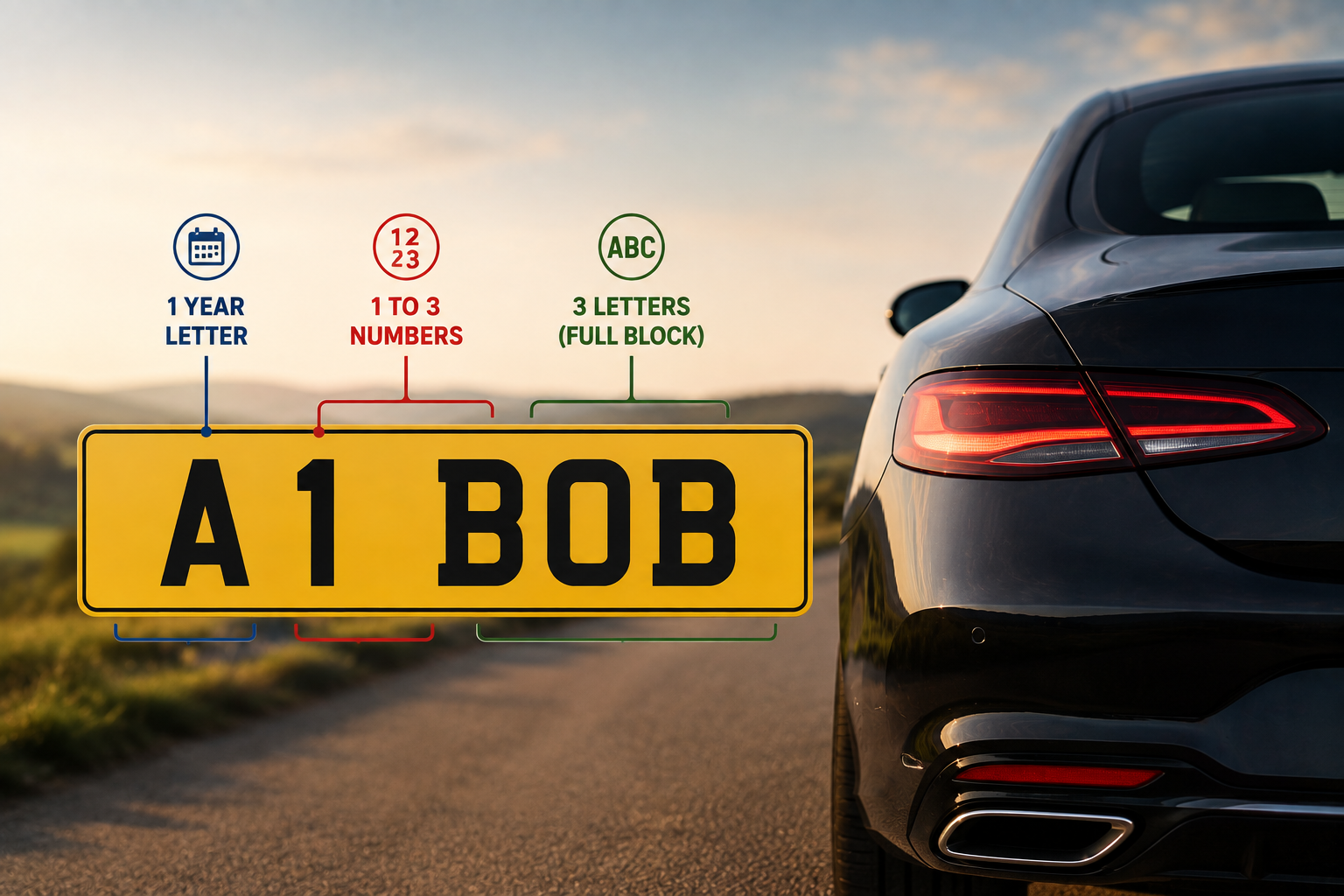
A prefix registration is the format the UK used between August 1983 and August 2001. It reads: a single year letter, then one to three numbers, then a three-letter sequence — A1 BOB, J8 ACK, M900 LOU, V116 CKY.
The name comes from where the age identifier sits. On a suffix plate (1963–1983) the year letter is on the end, ABC 123A; on a prefix plate it moved to the front; on the current style the age became two digits in the middle, AB26 CDE. We compare all four generations in our UK number plate format guide.
The format's most useful quirk is its shape: the numbers sit in the middle, so the plate splits into letter — number — three letters. That is exactly the shape of a name.
From 25 years in the trade: the single most common misreading we hear on the phone is people quoting a prefix plate as though the year letter belongs to the word. S444 NDY is not "S-Sandy" — it is an S-registration (1998) that happens to read SANDY. Once customers see the year letter as a separate thing that came free with the plate, the whole format clicks.
How do you read the year letter?
Three steps. Take the first character — always a letter, always the issue period. Ignore the numbers — one to three digits, purely a serial, no age information at all. Read the last three letters as the word, because that is where the personalisation lives.
Two things catch people out. I, O, Q, U and Z were never used as prefix year letters — I and O read as 1 and 0, Q was reserved for vehicles of uncertain age, U reads as V. And for most of the format's life the letter changed on 1 August, not 1 January, so an M-reg car is a 1994 or 1995 car depending on the month.
What is the full prefix year letter table?
Every prefix letter issued, with the period it covers. Note the change at the bottom: from 1999 DVLA moved to two changeovers a year, so the last five letters each cover six months.
| Year letter | Issued from | Issued to | Example |
|---|---|---|---|
| A | 1 Aug 1983 | 31 Jul 1984 | A1 BOB |
| B | 1 Aug 1984 | 31 Jul 1985 | B12 NUT |
| C | 1 Aug 1985 | 31 Jul 1986 | C5 TOM |
| D | 1 Aug 1986 | 31 Jul 1987 | D29 AVE |
| E | 1 Aug 1987 | 31 Jul 1988 | E25 SLA |
| F | 1 Aug 1988 | 31 Jul 1989 | F360 NUT |
| G | 1 Aug 1989 | 31 Jul 1990 | G9 BBY |
| H | 1 Aug 1990 | 31 Jul 1991 | H10 TTY |
| J | 1 Aug 1991 | 31 Jul 1992 | J8 ACK |
| K | 1 Aug 1992 | 31 Jul 1993 | K44 TEY |
| L | 1 Aug 1993 | 31 Jul 1994 | L15 ONN |
| M | 1 Aug 1994 | 31 Jul 1995 | M2 FLY |
| N | 1 Aug 1995 | 31 Jul 1996 | N11 DYS |
| P | 1 Aug 1996 | 31 Jul 1997 | P3 RGD |
| R | 1 Aug 1997 | 31 Jul 1998 | R11 NGE |
| S | 1 Aug 1998 | 28 Feb 1999 | S444 NDY |
| T | 1 Mar 1999 | 31 Aug 1999 | T20 NYY |
| V | 1 Sep 1999 | 29 Feb 2000 | V12 NEW |
| W | 1 Mar 2000 | 31 Aug 2000 | W7 GHT |
| X | 1 Sep 2000 | 28 Feb 2001 | X5 RAY |
| Y | 1 Mar 2001 | 31 Aug 2001 | Y1 JAY |
After Y came the current two-digit style, starting with the 51 identifier in September 2001 — and no further prefix registrations have ever been issued. The letters I, O, Q, U and Z were never used.
Why did prefix plates stop in 2001?
Arithmetic, mostly. The format allows only 21 usable year letters, and by 1999 the annual changeover had been split in two (S then T, V then W, X then Y) partly to smooth the enormous August spike in new-car sales. That bought two years, not a decade — and a twice-yearly system needed identifiers that could run indefinitely, which the numeric AB26 CDE format does.
The consequence for buyers: the supply of prefix plates is fixed forever. Every A-to-Y plate that exists already exists — the same structural argument that underpins dateless registrations, but with a far larger pool and therefore far more sensible prices.
Why are prefix plates the easiest route to a name or initials?
Because of that trailing block of three letters. A dateless plate gives you one to three letters and a number — perfect for two initials, rarely enough for a name. A current-style plate gives you three random letters stuck behind an area code and age number you cannot choose. A prefix plate gives you three free letters plus a leading letter you can often press into service as the first letter of the name itself.
| What you want | How a prefix plate does it | Real example (on offer with us today) |
|---|---|---|
| A first name | Year letter + numbers stand in for the middle, last three finish the word | S444 NDY (Sandy), D19 NNA (Dianna) |
| Three initials | The trailing three-letter block is exactly three initials | B16 HGV, 111 SCM-style readings |
| A name with the year letter doing the work | Leading letter is the name's first letter | J8 ACK (Jack), M900 LOU (Mou/Lou), H10 TTY (Hotty) |
| A word or job | Three letters carry the word, numbers fill the middle | W7 GHT (Wright), R11 NGE (Range), M2 FLY |
| A car or brand reference | Year letter matched to the marque | P911 NOW (Porsche 911), V12 NEW, V6 GTR |
Number-for-letter substitutions work here as they do elsewhere — 1 for I, 5 for S, 0 for O, 4 for A, 8 for B. Our guide to personalised plates for names and initials covers the substitution rules and how to shortlist properly.
From 25 years in the trade: if your name runs to five or six letters, start with prefix. We watch people spend weeks hunting a dateless mark for a name dateless simply cannot spell, then find the reading they wanted on a prefix plate in ten minutes. Prefix is not the compromise format — for names, it is usually the correct one.
How much do prefix number plates cost?
Real pricing, taken from our own private plates on offer page today rather than an invented range.
| Registration | Reads as | Price |
|---|---|---|
| P3 RGD | PERGD / initials | £979 |
| M900 LOU | LOU | £1,895 |
| J321 MMA | EMMA | £1,995 |
| V12 NEW | V12 | £2,995 |
| P911 NOW | Porsche 911 | £3,495 |
| D29 AVE | DAVE | £3,500 |
| J2 NNY | JENNY | £4,995 |
| A1 ASA | ASA | £4,995 |
| A992 POR | Porsche 992 | £5,995 |
| S444 NDY | SANDY | £6,995 |
| M47 TYY | MATTY | £8,995 |
| J8 ACK | JACK | £9,995 |
| L1 MEY | LIMEY | £12,950 |
| V6 GTR | Nissan GT-R | £14,995 |
| M4 RTY | MARTY | £99,995 |
Prices are the registration price and were re-checked against Right Reg live stock on 29 August 2026. Some marks also carry VAT — J321 MMA and D29 AVE are two of them — so check the plate's own page for the all-in figure. Stock changes daily.
On top of the purchase price, DVLA charges an £80 assignment (transfer) fee — confirmed on GOV.UK's private number plates guidance — plus a set of physical plates from a registered supplier, typically £20–£40 a pair, made only on production of ID and proof of entitlement.
| Cost | Typical figure | Who charges it |
|---|---|---|
| The registration itself | £979–£99,995 (see above) | Dealer or DVLA auction |
| DVLA assignment fee | £80 | DVLA |
| Physical acrylic plates | £20–£40 per pair | Registered plate supplier |
| Retention (keeping it off a car) | Included in the £80 when you take it off | DVLA |
| Annual running cost | £0 | — |
Fees correct as of 29 August 2026. Check GOV.UK for the current figure before you budget.
What decides the price of one prefix plate over another?
Four things, roughly in order of weight. How exact the reading is — D29 AVE at £3,500 is a clean DAVE; a plate needing three substitutions is worth a fraction of that. How common the name is — popular first names have deep buyer pools, rare surnames read beautifully to one family and nobody else. Digit count — J2 NNY looks tidier than J321 MMA and prices higher for the same reading. Whether the year letter helps — J8 ACK uses its J, S444 NDY does not need its S, and plates where the letter forms part of the word carry a premium.
From 25 years in the trade: notice what is not on that list — the age of the car it goes on. Buyers worry that a 1994 M-reg mark will make a 2024 car look old. In 25 years of fitting them we have never known anyone read a personalised plate as an age. They read the name.
Can a prefix plate go on any car?
No — and this is the rule that catches buyers out. A registration can never make a vehicle appear newer than it is. A Y-prefix mark (2001) can go on a 2001 car or anything older, but not on a 2015 car, because that would disguise the vehicle's true age.
Read it the other way round and it becomes a buying strategy: the newer your car, the more of the prefix range is open to you. Anything registered from 2001 onwards can wear any prefix letter from A to Y — which is why the format suits modern daily drivers, and why owners of 1980s classics have to work harder.
Display rules apply as normal: correct font and spacing, no altered characters, no shuffling the gaps to force a word. Incorrectly displayed plates risk MOT failure and a fine of up to £1,000 under GOV.UK's number plate display rules; our spacing law guide covers the detail.
How do you buy and transfer one?
The mechanics are the same as for any private registration:
- Search for the reading, not the plate — put the name or initials into our number plate finder or browse plates by name.
- Check it is legal for your vehicle using the age rule above.
- Buy it. You receive either a V750 certificate of entitlement or a V778 retention document.
- Assign it online through DVLA, or by post on form V317, paying the £80 fee — the full process is on GOV.UK.
- Get plates made by a registered supplier, taking ID and your V5C or V750/V778.
Online assignments are usually effective immediately; postal V317 applications take longer. Our DVLA transfer guide walks through the paperwork and the complete buyer's guide covers what to check before you pay. Already own a prefix mark? Our free valuation will price it, and we buy as well as sell via sell my number plate.
FAQs
What is a prefix number plate?
A prefix number plate is a UK registration issued between August 1983 and August 2001, in the format of one year letter, one to three numbers and three letters — for example A1 BOB or M47 TYY. The opening letter identifies when it was first issued.
What years do prefix number plate letters cover?
A covers August 1983 to July 1984 and each following letter covers a year from 1 August. From 1999 the changeover happened twice a year: S runs August 1998 to February 1999, T March to August 1999, V September 1999 to February 2000, W March to August 2000, X September 2000 to February 2001 and Y March to August 2001.
Which letters were never used as prefixes?
I, O, Q, U and Z were never issued as prefix year letters. I and O read as 1 and 0, Q was reserved for vehicles of uncertain age, U reads too easily as V, and Z was reserved for other uses.
Can I put a prefix plate on a newer car?
Yes. A registration can never make a vehicle look newer than it is, but it can make it look older. So any car registered from 2001 onwards can legally carry any prefix plate from A to Y. A 2015 car cannot carry a plate implying it is newer than 2015.
How much does a prefix number plate cost?
On Right Reg's live stock on 29 August 2026, prefix plates run from £979 for P3 RGD to £99,995 for M4 RTY, with most recognisable first-name plates falling between £3,000 and £10,000. DVLA then charges an £80 assignment fee to put the registration on a vehicle.
Are prefix plates a good first personalised plate?
They are the most accessible way into a personal registration: the three-letter block at the end spells names and initials that dateless marks cannot, and far more of them exist. That combination of readability and supply keeps prices sensible without any compromise in quality.
Will a prefix plate hold its value?
No new prefix registrations will ever be issued, so supply is permanently fixed. Value holds best on exact, short readings of common names where the year letter forms part of the word — J8 ACK rather than a plate needing several substitutions.
How long does it take to transfer a prefix plate?
An online DVLA assignment is usually effective straight away once the application is accepted. A postal application on form V317 takes longer, as it depends on DVLA processing times and the return of your documents.
TL;DR: A prefix registration is the 1983–2001 format — one year letter, one to three numbers, then three letters, as in A1 BOB or M47 TYY. The opening letter dates the car: A is August 1983, Y is March 2001, and from 1999 the letter changed twice a year rather than once. Because the last three characters are a full three-letter block, prefix marks are the most reliable place to find real names and initials. On our own offers page today prefix plates run from £979 (P3 RGD) to £99,995 (M4 RTY), with most name plates landing between £3,000 and £10,000. Add DVLA's £80 assignment fee.
Contents
- What is a prefix number plate?
- How do you read the year letter?
- What is the full prefix year letter table?
- Why did prefix plates stop in 2001?
- Why are prefix plates the easiest route to a name or initials?
- How much do prefix number plates cost?
- What decides the price of one prefix plate over another?
- Can a prefix plate go on any car?
- How do you buy and transfer one?
- FAQs
What is a prefix number plate?
A prefix registration is the format the UK used between August 1983 and August 2001. It reads: a single year letter, then one to three numbers, then a three-letter sequence — A1 BOB, J8 ACK, M900 LOU, V116 CKY.
The name comes from where the age identifier sits. On a suffix plate (1963–1983) the year letter is on the end, ABC 123A; on a prefix plate it moved to the front; on the current style the age became two digits in the middle, AB26 CDE. We compare all four generations in our UK number plate format guide.
The format's most useful quirk is its shape: the numbers sit in the middle, so the plate splits into letter — number — three letters. That is exactly the shape of a name.
From 30 years in the trade: the single most common misreading we hear on the phone is people quoting a prefix plate as though the year letter belongs to the word. S444 NDY is not "S-Sandy" — it is an S-registration (1998) that happens to read SANDY. Once customers see the year letter as a separate thing that came free with the plate, the whole format clicks.
How do you read the year letter?
Three steps. Take the first character — always a letter, always the issue period. Ignore the numbers — one to three digits, purely a serial, no age information at all. Read the last three letters as the word, because that is where the personalisation lives.
Two things catch people out. I, O, Q, U and Z were never used as prefix year letters — I and O read as 1 and 0, Q was reserved for vehicles of uncertain age, U reads as V. And for most of the format's life the letter changed on 1 August, not 1 January, so an M-reg car is a 1994 or 1995 car depending on the month.
What is the full prefix year letter table?
Every prefix letter issued, with the period it covers. Note the change at the bottom: from 1999 DVLA moved to two changeovers a year, so the last five letters each cover six months.
| Year letter | Issued from | Issued to | Example |
|---|---|---|---|
| A | 1 Aug 1983 | 31 Jul 1984 | A1 BOB |
| B | 1 Aug 1984 | 31 Jul 1985 | B12 NUT |
| C | 1 Aug 1985 | 31 Jul 1986 | C5 TOM |
| D | 1 Aug 1986 | 31 Jul 1987 | D29 AVE |
| E | 1 Aug 1987 | 31 Jul 1988 | E25 SLA |
| F | 1 Aug 1988 | 31 Jul 1989 | F360 NUT |
| G | 1 Aug 1989 | 31 Jul 1990 | G9 BBY |
| H | 1 Aug 1990 | 31 Jul 1991 | H10 TTY |
| J | 1 Aug 1991 | 31 Jul 1992 | J8 ACK |
| K | 1 Aug 1992 | 31 Jul 1993 | K44 TEY |
| L | 1 Aug 1993 | 31 Jul 1994 | L15 ONN |
| M | 1 Aug 1994 | 31 Jul 1995 | M2 FLY |
| N | 1 Aug 1995 | 31 Jul 1996 | N11 DYS |
| P | 1 Aug 1996 | 31 Jul 1997 | P3 RGD |
| R | 1 Aug 1997 | 31 Jul 1998 | R11 NGE |
| S | 1 Aug 1998 | 28 Feb 1999 | S444 NDY |
| T | 1 Mar 1999 | 31 Aug 1999 | T20 NYY |
| V | 1 Sep 1999 | 29 Feb 2000 | V12 NEW |
| W | 1 Mar 2000 | 31 Aug 2000 | W7 GHT |
| X | 1 Sep 2000 | 28 Feb 2001 | X5 RAY |
| Y | 1 Mar 2001 | 31 Aug 2001 | Y1 JAY |
After Y came the current two-digit style, starting with the 51 identifier in September 2001 — and no further prefix registrations have ever been issued. The letters I, O, Q, U and Z were never used.
Why did prefix plates stop in 2001?
Arithmetic, mostly. The format allows only 21 usable year letters, and by 1999 the annual changeover had been split in two (S then T, V then W, X then Y) partly to smooth the enormous August spike in new-car sales. That bought two years, not a decade — and a twice-yearly system needed identifiers that could run indefinitely, which the numeric AB26 CDE format does.
The consequence for buyers: the supply of prefix plates is fixed forever. Every A-to-Y plate that exists already exists — the same structural argument that underpins dateless registrations, but with a far larger pool and therefore far more sensible prices.
Why are prefix plates the easiest route to a name or initials?
Because of that trailing block of three letters. A dateless plate gives you one to three letters and a number — perfect for two initials, rarely enough for a name. A current-style plate gives you three random letters stuck behind an area code and age number you cannot choose. A prefix plate gives you three free letters plus a leading letter you can often press into service as the first letter of the name itself.
| What you want | How a prefix plate does it | Real example (on offer with us today) |
|---|---|---|
| A first name | Year letter + numbers stand in for the middle, last three finish the word | S444 NDY (Sandy), D19 NNA (Dianna) |
| Three initials | The trailing three-letter block is exactly three initials | B16 HGV, 111 SCM-style readings |
| A name with the year letter doing the work | Leading letter is the name's first letter | J8 ACK (Jack), M900 LOU (Mou/Lou), H10 TTY (Hotty) |
| A word or job | Three letters carry the word, numbers fill the middle | W7 GHT (Wright), R11 NGE (Range), M2 FLY |
| A car or brand reference | Year letter matched to the marque | P911 NOW (Porsche 911), V12 NEW, V6 GTR |
Number-for-letter substitutions work here as they do elsewhere — 1 for I, 5 for S, 0 for O, 4 for A, 8 for B. Our guide to personalised plates for names and initials covers the substitution rules and how to shortlist properly.
From 30 years in the trade: if your name runs to five or six letters, start with prefix. We watch people spend weeks hunting a dateless mark for a name dateless simply cannot spell, then find the reading they wanted on a prefix plate in ten minutes. Prefix is not the compromise format — for names, it is usually the correct one.
How much do prefix number plates cost?
Real pricing, taken from our own private plates on offer page today rather than an invented range.
| Registration | Reads as | Price |
|---|---|---|
| P3 RGD | PERGD / initials | £979 |
| V21 VVV | Triple V | £1,275 |
| M900 LOU | LOU | £1,895 |
| J321 MMA | EMMA | £1,995 |
| V12 NEW | V12 | £2,995 |
| P911 NOW | Porsche 911 | £3,495 |
| D29 AVE / D28 AVE | DAVE | £3,500 each |
| B12 NUT | BIG NUT | £3,995 |
| J2 NNY | JENNY | £4,995 |
| A1 ASA | ASA | £4,995 |
| A992 POR | Porsche 992 | £5,995 |
| A13 RRY | BARRY | £6,780 |
| S444 NDY | SANDY | £6,995 |
| M47 TYY | MATTY | £8,995 |
| J8 ACK | JACK | £9,995 |
| L1 MEY | LIMEY | £12,950 |
| V6 GTR | Nissan GT-R | £14,995 |
| M4 RTY | MARTY | £99,995 |
Prices correct as of 21 August 2026 and change as stock sells. Source: Right Reg live stock.
On top of the purchase price, DVLA charges an £80 assignment (transfer) fee — confirmed on GOV.UK's private number plates guidance — plus a set of physical plates from a registered supplier, typically £20–£40 a pair, made only on production of ID and proof of entitlement.
| Cost | Typical figure | Who charges it |
|---|---|---|
| The registration itself | £979–£99,995 (see above) | Dealer or DVLA auction |
| DVLA assignment fee | £80 | DVLA |
| Physical acrylic plates | £20–£40 per pair | Registered plate supplier |
| Retention (keeping it off a car) | Included in the £80 when you take it off | DVLA |
| Annual running cost | £0 | — |
Fees correct as of 21 August 2026. Check GOV.UK for the current figure before you budget.
What decides the price of one prefix plate over another?
Four things, roughly in order of weight. How exact the reading is — D29 AVE at £3,500 is a clean DAVE; a plate needing three substitutions is worth a fraction of that. How common the name is — popular first names have deep buyer pools, rare surnames read beautifully to one family and nobody else. Digit count — J2 NNY looks tidier than J321 MMA and prices higher for the same reading. Whether the year letter helps — J8 ACK uses its J, S444 NDY does not need its S, and plates where the letter forms part of the word carry a premium.
From 30 years in the trade: notice what is not on that list — the age of the car it goes on. Buyers worry that a 1994 M-reg mark will make a 2024 car look old. In fifteen years of fitting them we have never known anyone read a personalised plate as an age. They read the name.
Can a prefix plate go on any car?
No — and this is the rule that catches buyers out. A registration can never make a vehicle appear newer than it is. A Y-prefix mark (2001) can go on a 2001 car or anything older, but not on a 2015 car, because that would disguise the vehicle's true age.
Read it the other way round and it becomes a buying strategy: the newer your car, the more of the prefix range is open to you. Anything registered from 2001 onwards can wear any prefix letter from A to Y — which is why the format suits modern daily drivers, and why owners of 1980s classics have to work harder.
Display rules apply as normal: correct font and spacing, no altered characters, no shuffling the gaps to force a word. Incorrectly displayed plates risk MOT failure and a fine of up to £1,000 under GOV.UK's number plate display rules; our spacing law guide covers the detail.
How do you buy and transfer one?
The mechanics are the same as for any private registration:
- Search for the reading, not the plate — put the name or initials into our number plate finder or browse plates by name.
- Check it is legal for your vehicle using the age rule above.
- Buy it. You receive either a V750 certificate of entitlement or a V778 retention document.
- Assign it online through DVLA, or by post on form V317, paying the £80 fee — the full process is on GOV.UK.
- Get plates made by a registered supplier, taking ID and your V5C or V750/V778.
Online assignments are usually effective immediately; postal V317 applications take longer. Our DVLA transfer guide walks through the paperwork and the complete buyer's guide covers what to check before you pay. Already own a prefix mark? Our free valuation will price it, and we buy as well as sell via sell my number plate.
FAQs
What is a prefix number plate?
A prefix number plate is a UK registration issued between August 1983 and August 2001, in the format of one year letter, one to three numbers and three letters — for example A1 BOB or M47 TYY. The opening letter identifies when it was first issued.
What years do prefix number plate letters cover?
A covers August 1983 to July 1984 and each following letter covers a year from 1 August. From 1999 the changeover happened twice a year: S runs August 1998 to February 1999, T March to August 1999, V September 1999 to February 2000, W March to August 2000, X September 2000 to February 2001 and Y March to August 2001.
Which letters were never used as prefixes?
I, O, Q, U and Z were never issued as prefix year letters. I and O read as 1 and 0, Q was reserved for vehicles of uncertain age, U reads too easily as V, and Z was reserved for other uses.
Can I put a prefix plate on a newer car?
Yes. A registration can never make a vehicle look newer than it is, but it can make it look older. So any car registered from 2001 onwards can legally carry any prefix plate from A to Y. A 2015 car cannot carry a plate implying it is newer than 2015.
How much does a prefix number plate cost?
On Right Reg's live stock on 21 August 2026, prefix plates run from £979 for P3 RGD to £99,995 for M4 RTY, with most recognisable first-name plates falling between £3,000 and £10,000. DVLA then charges an £80 assignment fee to put the registration on a vehicle.
Are prefix plates a good first personalised plate?
They are the most accessible way into a personal registration: the three-letter block at the end spells names and initials that dateless marks cannot, and far more of them exist. That combination of readability and supply keeps prices sensible without any compromise in quality.
Will a prefix plate hold its value?
No new prefix registrations will ever be issued, so supply is permanently fixed. Value holds best on exact, short readings of common names where the year letter forms part of the word — J8 ACK rather than a plate needing several substitutions.
How long does it take to transfer a prefix plate?
An online DVLA assignment is usually effective straight away once the application is accepted. A postal application on form V317 takes longer, as it depends on DVLA processing times and the return of your documents.